
Colonial Heights, Virginia · Mold Remediation & Cleanup
Mold Removal Colonial Heights VA
Rainwater that runs toward the foundation instead of away from it. A crawl space that never loses its summer dampness. Plaster in an older brick house that stains a little more every spring. Mold removal in Colonial Heights VA begins with the water behind those signs: where it enters, what it has soaked, and how to stop it before the affected materials are cleaned or cut out under containment and the space is dried.
Skip the guesswork. Call, describe the stain or smell and the room it is in, and we will point you to the right first step.
- Source Before ScopeThe water behind the growth is found first.
- Contained WorkThe affected work area is controlled where appropriate.
- HEPA Air FiltrationFiltered air keeps dust out of the rest of the house.
- Documented ScopeA written plan backed by photos and readings.
- Residential & CommercialHouses, rental units and small commercial spaces.
Mold Removal in Colonial Heights VA in Brief
- Jobs we take on
- Growth, wet building materials and the moisture problems behind them.
- When to Call
- When a leak happened, damp keeps coming back, or a stale smell will not leave.
- What Happens First
- A conversation about the house, then a look at where water is getting in and how far it reached.
- Where We Serve
- All of Colonial Heights; ask us about addresses near the line.
- The Goal
- Correct the moisture condition, control the work area, clean or remove affected materials as needed, and dry the space.
The work
Mold Remediation for Colonial Heights Homes & Properties
Remediation that lasts starts with the moisture, not the stain. We read drywall, framing, subfloor and masonry with moisture meters, and the pattern of readings usually shows where the water is coming from: a leak in a supply line, condensation around HVAC equipment, rain finding its way through a foundation wall or a roof detail feeding the attic.
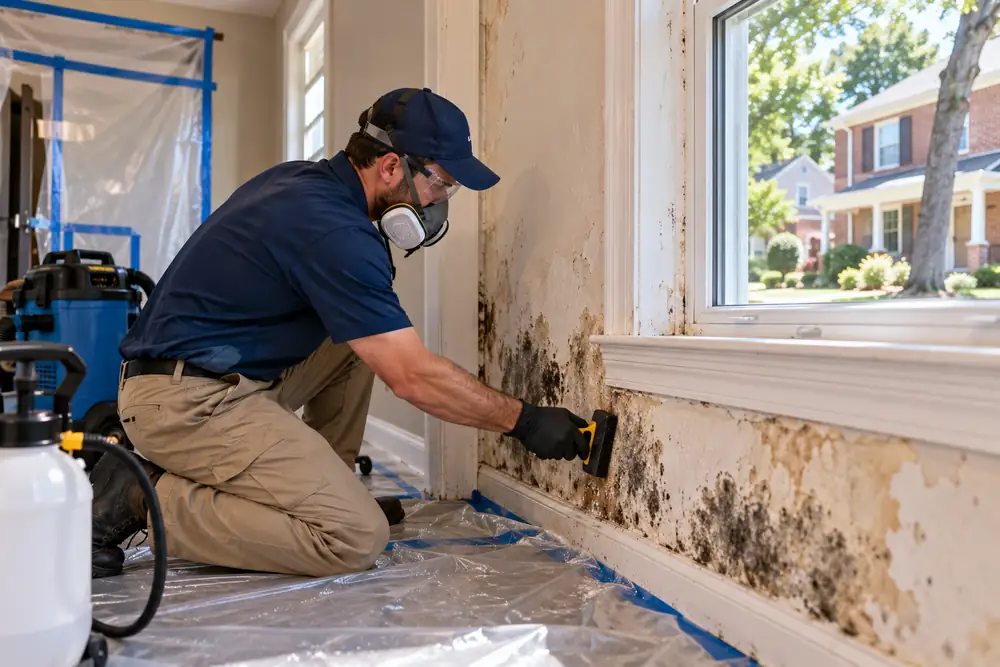
Once we know where the water comes from, we decide what each material needs. Soaked drywall, insulation and pad with growth are cut out and bagged. Block, brick and framing are normally cleaned where they stand. The room is sealed off, air scrubbers run during removal, and every exposed surface is vacuumed with HEPA equipment.
Drying follows, and nothing is closed up until the meters agree. The same sequence applies under the house, in the basement or up in the attic, just at a different size. You finish with photos, numbers and a plain summary of the work and anything to monitor.
Situations
Where Does Moisture Cause Trouble in Colonial Heights Properties?
Many homes will never deal with any of these. When growth does show up, it nearly always connects to one of them.
Lower Level Near the River or a Creek
What may be happeningSome low lying properties sit where the ground stays wetter after storms, so water can reach a foundation more easily.
What should be checkedWater entry points at the wall base, the slab edge, sump operation and how the yard drains.
Damp Crawl Space Under an Older House
What may be happeningBare dirt, a dripping pipe or muggy summer air keeps the joists and batts wet.
What should be checkedMoisture in the wood, the plastic ground cover, vents and any plumbing overhead.
Older Brick or Plaster Home
What may be happeningMasonry and plaster hold and release moisture differently, and decades of repairs can hide the path water takes.
What should be checkedOld mortar, earlier repairs, sills, flashing and readings on original plaster and wood.
Suburban Home With Runoff Against the Foundation
What may be happeningShort downspouts or grading that slopes toward the house send roof water straight to the foundation wall.
What should be checkedDownspout discharge, grading, the foundation wall inside and out, and the materials along the base.
Bathroom With Persistent Condensation
What may be happeningAn exhaust fan that moves too little air leaves the ceiling damp and lets moisture into the wall cavity.
What should be checkedFan duct and termination, ceiling drywall, the cavity behind the tub and caulk lines.
HVAC or Utility Moisture
What may be happeningA plugged AC drain, a rusted pan or sweating bare ducts drip water onto hidden framing.
What should be checkedCondensate line and pan, duct insulation, nearby framing and the ceiling or floor below.
Cause and effect
The Moisture Behind the Mold
Take away the moisture and the rest of the equation falls apart. Every home has spores floating around; trouble starts only when something stays wet. Federal guidance says to get soaked materials dry within a couple of days, so speed after a leak matters and every plan we write deals with the source. Scrubbing a wall that keeps getting wet just books the next visit.
Around the city
What Local Factors Affect Colonial Heights Homes?
The City of Colonial Heights is an independent city bordered by Chesterfield County, Petersburg and Prince George County, framed by Swift Creek and the Appomattox River, and built up over more than a century. That combination is what shapes moisture problems here.
- 1815Violet Bank house built; the later historic district takes its name from it
- 1908Start of the suburban period recognized in the Violet Bank Historic District
- 1916Planning begins for Chesterfield Highlands, one of the city’s largest early planned suburbs
- 1920 to 1940Most Chesterfield Highlands homes built, many Craftsman influenced or kit houses
- 1945 to 1956Post war building adds modest homes in both districts
Appomattox River & Swift Creek
Colonial Heights sits between Swift Creek and the Appomattox River, and the City notes that runoff reaches Swift Creek, Old Town Creek, the Appomattox River and local ponds and streams. For properties near those waterways or in low spots, drainage and water entry paths deserve a closer look. Most homes in the city are not affected by this at all.
Stormwater & Runoff
The City runs a citywide Stormwater Management Program covering the control, operation, inspection, maintenance and oversight of runoff and its storm sewer system. That public network is separate from what happens on your lot: downspouts, grading, foundation drainage and sump systems decide whether rain reaches a basement or crawl space.
Floodplain Awareness
Federal flood maps mark areas of higher risk, but a map label is not a flood history, and houses outside the shaded areas still get water in hard storms. What has happened at your own address tells us more.
Historic Neighborhoods
Virginia DHR describes Chesterfield Highlands as one of the largest and earliest planned suburbs in Colonial Heights, with most homes built between 1920 and 1940 and influenced by the Craftsman style and mail order kit houses. The Violet Bank Historic District takes in the Colonial Heights Extended subdivision and more than half of Riverside Park, including kit houses from Sears, Aladdin and Gordon Van Tine.
Mixed Age Housing
One city, several building generations: early 20th century frame and kit houses, post war brick ranches and newer construction. Each has different wall assemblies and different ways for moisture to move, so the same symptom can mean different things in two houses a few streets apart.
Older Materials Need Careful Assessment
Historic brick, plaster, old lumber and original windows react to water in their own way, and decades of repairs complicate things further. We measure each material and choose cleaning and drying over demolition whenever they will do the job.
Local source: City of Colonial Heights Stormwater Management
Start to finish
Colonial Heights Mold Remediation, Step by Step
- 1Opening CallWhat you see, where, and since when.
- 2Moisture & Area AssessmentMeters find the wet zone and where it starts.
- 3Containment PlanningPlastic and negative air confine the work.
- 4Removal & CleanupSoft materials out, hard surfaces scrubbed.
- 5HEPA Filtration & ControlsAir scrubbers and HEPA vacuums never stop.
- 6Drying & Moisture CorrectionLeak corrected, structure dried and measured.
- 7Final Review & DocumentationPhotos, readings and next steps.
Each stage is explained in more depth on Our Process page.
Inside the home
Parts of the House We Treat
- Basements & Lower LevelsFoundation walls where runoff or ground moisture gets in.
- Crawl SpacesJoists, insulation and subfloor over damp soil.
- AtticsSheathing under roof leaks and fan exhaust.
- BathroomsCeilings and walls with too little ventilation.
- KitchensKitchen cabinets, ice makers and dishwashers.
- Laundry & Utility AreasWashers, water heaters and utility tubs.
- Bedrooms & Living SpacesOutside walls, closets and sills that sweat in winter.
- HVAC & Mechanical AreasFurnaces, AC coils, drain pans and ducts.
These images show typical work, not a specific Colonial Heights home.
Point us to the stain, damp patch or growth.
We can explain the next practical step on the phone, whether that is drying, a moisture fix or remediation.
Water damage restoration
Water Damage Restoration in Colonial Heights, VA
Water damage restoration in Colonial Heights works best when drying starts within hours, not days. We pick up day and night for flooded basements, split pipes and leaking appliances anywhere in town.
Rain that runs toward a foundation, a failed washer hose or a pipe that froze in an outside wall can soak carpet, pad and drywall quickly. We extract the water, decide with a moisture meter what can stay, and keep dehumidifiers and air movers running until every reading is back to normal. Homes near the Appomattox and older houses with crawl spaces get extra attention under the floor.
- Stop the water and protect belongings
- Extract and measure how far it spread
- Run drying equipment with daily readings
- Rule out growth before rebuilding
Read how drying is planned and measured in our water damage restoration guide.
What Does Mold Removal Cost in Colonial Heights?
A fair Colonial Heights price depends on what the visit finds. Price depends on:
- Affected area size
- Materials
- Access
- Moisture source
- Barriers needed
- Volume of material out
- Drying days
- Repairs
You approve the scope and price first.
Why Do Colonial Heights Property Owners Choose Professional Remediation?
- ClarityYou hear what was found and why before work starts.
- ContainmentBarriers hold the dust in one room.
- Root Cause FixedWe fix the dampness, not only the stain.
- Professional EquipmentMeters, air scrubbers and commercial dehumidifiers.
- DocumentationA written scope with photos and meter data.
- Clear Next StepsYou leave knowing what to keep an eye on.
Read more about our Mold Remediation approach.
Service area
Serving Colonial Heights and Nearby Areas
From the older streets near Violet Bank and Chesterfield Highlands to the newer subdivisions, Colonial Heights owners, landlords and businesses call us. Close to the city line? Phone first and we will confirm.
We do not have a Colonial Heights office. Our team works from 715 Hull St, Richmond, VA 23224, shown on the map, and Colonial Heights visits are scheduled by phone.
Richmond
Downtown · The Fan · Church Hill · Manchester · Museum District · West End
Henrico County
Short Pump · Glen Allen
Chesterfield County
Midlothian · Bon Air
Hanover County
Nearby Cities
Petersburg · Colonial Heights · Fredericksburg · Newport News
FAQ
Colonial Heights Mold & Moisture Questions
Seeing Stains or Smelling Mustiness?
Describe what is going on at your Colonial Heights address and we will tell you whether it calls for a drainage fix, remediation or a closer look.
Mold Removal Colonial Heights VA · (804) 392-9142